
learn
How Tannase Works on Tannins | Tannora
Learn how Tannase (Tannin Acyl Hydrolase) hydrolyzes tannins to improve beverage clarity, flavor balance, extract handling, and process control.
Request pricing Learn how Tannase (Tannin Acyl Hydrolase) hydrolyzes tannins to improve beverage clarity, flavor balance, extract handling, and process control.
Request pricingTannase is used when tannins are doing too much: building haze, tightening mouthfeel, slowing separation, masking aromatics, or making extract performance unpredictable. Tannora focuses on tannase for practical industrial use — where the goal is not simply “less tannin,” but better control over how tannins behave in a real formulation or process stream.
Tannase (Tannin Acyl Hydrolase) catalyzes the hydrolysis of specific bonds in hydrolyzable tannins, especially gallotannin-type structures. In application terms, it can convert bulky, complexing polyphenols into smaller phenolic components that are easier to manage in beverage, extract, and fermentation workflows.

Tannins are a broad class of plant polyphenols. They are common in tea, wine, coffee, fruit juice, botanicals, oak-derived ingredients, pulses, grains, and many fermentation inputs.
For processing teams, tannins matter because they can:
Tannase is most relevant when the tannin profile contains hydrolyzable tannins, including gallotannins and related esters. It is less direct on condensed tannins, so substrate profiling and application context matter.
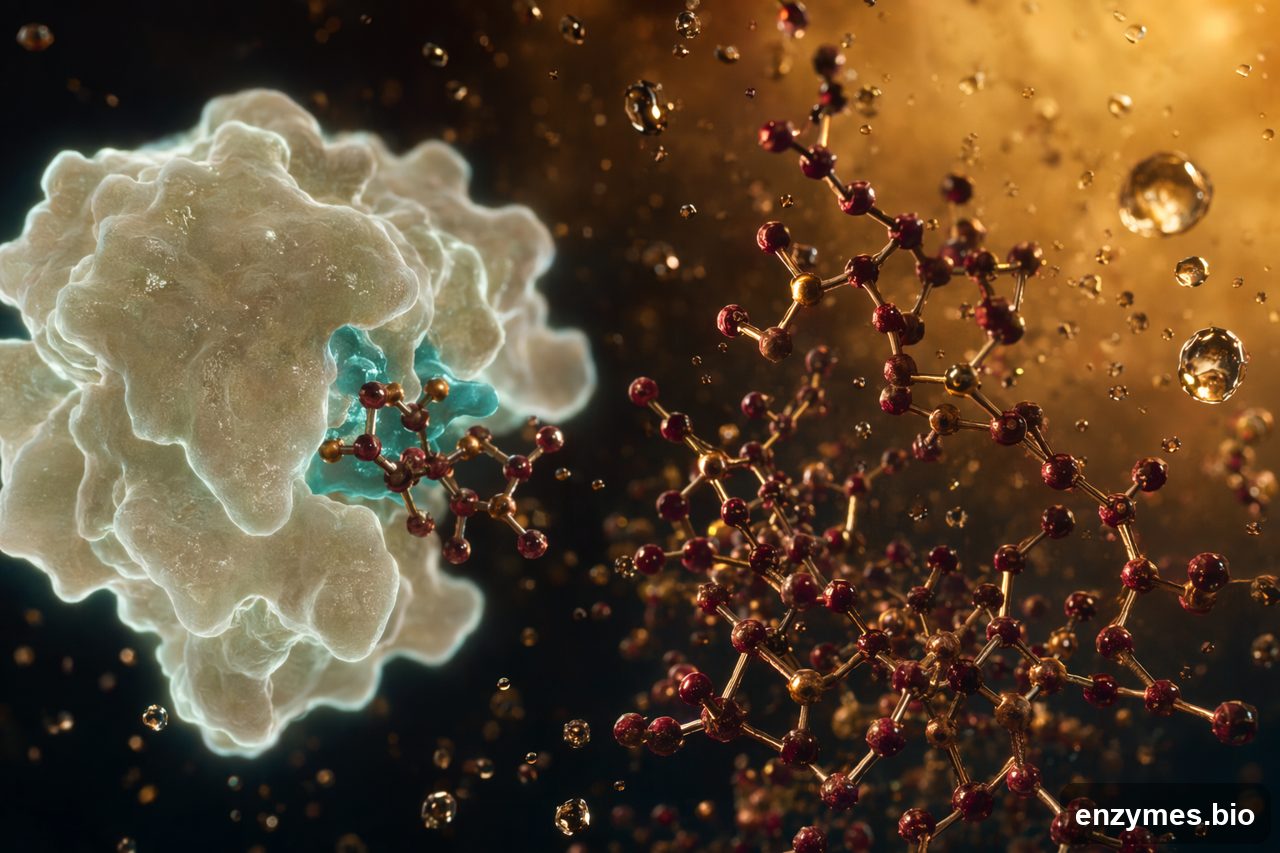
Tannase works by cleaving ester and depside bonds in tannin structures. Instead of leaving a large tannin cluster intact, the enzyme helps split selected linkages into smaller phenolic components.
In simplified terms:
The value is not just chemical conversion. The value is what that conversion does for the process: fewer heavy complexes, improved clarity potential, more refined sensory balance, and a more predictable downstream stream.
Large tannin structures are highly interactive. They can bind proteins, polysaccharides, minerals, color compounds, and other phenolics. That interaction can be desirable in some products, but it often causes processing problems.
By reshaping tannins, tannase can help reduce:
This is why tannase is used as a targeted processing tool rather than a generic additive. It modifies the chemistry upstream so the final system is easier to formulate, separate, polish, or standardize.

In tea systems, tannins contribute body, color, and identity — but they can also drive chill haze, sediment, and bitterness. Tannase can support clearer tea extracts, smoother taste, and more consistent performance in bottled or concentrated formats.
Typical objectives include:
In fruit and fermented beverage systems, tannase may be used to tune tannic intensity, reduce harshness, and improve clarification behavior. Its role depends heavily on raw material, phenolic profile, and process point.
Common goals include:
Botanical materials can carry complex tannin loads that affect taste, solubility, and extract appearance. Tannase can help manufacturers produce extracts with more controlled bitterness and better handling in powders, concentrates, and liquid ingredients.
Potential benefits include:
Tannin-rich feedstocks can inhibit microbial performance, bind nutrients, or complicate downstream recovery. Tannase can be used before, during, or after fermentation depending on the process objective and compatibility with the production organism or product matrix.
Useful outcomes may include:
The best point of addition depends on what problem the team is solving.
Before extraction: tannase can be used to alter tannin behavior early, helping create a cleaner extract profile from the start.
During extraction: it can work while tannins are being released, supporting improved handling of high-polyphenol materials.
After extraction: it can be applied as a correction or refinement step when bitterness, haze, or separation issues appear in the extracted phase.
Around fermentation: it can be positioned to reduce tannin interference or to influence the final phenolic profile.
Tannora application discussions focus on the process objective first: clarity, flavor refinement, yield improvement, separation, or specialty extract performance. The enzyme strategy should follow the product target, not the other way around.
Tannase performance depends on the matrix. A tea concentrate, a grape skin extract, and a fermented grain stream will not respond identically.
Important variables include:
Because tannase changes the interaction profile of phenolics, evaluation should include both analytical and sensory endpoints. A technically successful conversion still needs to match the product’s target taste, color, and stability.
When the substrate is suitable and the process is well designed, tannase can support:
Tannase is precise, but it is not universal.
It does not automatically remove every tannic note. It does not replace good raw material selection, extraction design, or clarification strategy. It is also not the same as fining, adsorption, or filtration. Those methods remove or separate components; tannase changes tannin chemistry so the matrix behaves differently.
The strongest programs often combine tannase with a clear process map: what tannin issue is being addressed, where the enzyme is introduced, what endpoint defines success, and how the treated stream will move downstream.
For B2B evaluation, begin with the real processing problem:
These answers determine whether tannase should be positioned as the primary solution, part of a broader enzyme system, or a targeted correction step.
Tannora is built around tannase application, not generic enzyme language. We help technical buyers frame the decision around the matrix, the desired product outcome, and the processing constraints that matter in production.
Use Tannora when you need a tannase discussion grounded in:
If you are evaluating tannase for a beverage, extract, fermentation, or specialty ingredient process, send the basic project context and the Tannora team will respond through this site’s own inquiry workflow.


Tell us your application and volume — we reply with pricing and lead time.