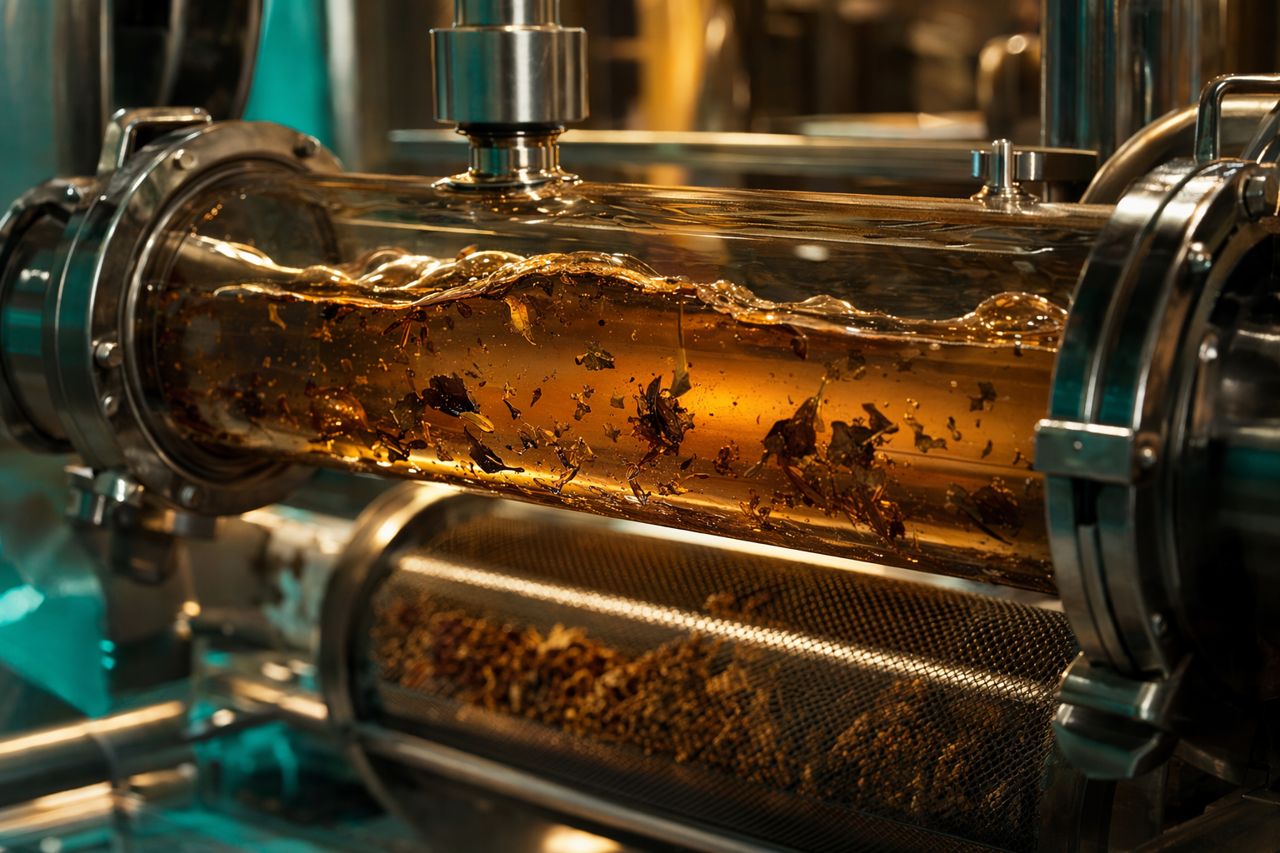
Operational guidance for tannase processing: pH, temperature, contact time, substrate profile, mixing, stop points, and trial design for beverage, extract, and fermentation applications.
Tannase (Tannin Acyl Hydrolase) is not a single-outcome processing aid. It is a controlled way to reshape tannin chemistry: reducing haze-forming interactions, softening astringency, improving extract handling, and increasing release of gallic-acid-related fractions where that is the target.
The result depends on the matrix. Tea, juice, wine, coffee, cocoa, botanical extracts, and fermentation inputs all carry different tannin structures, solids loads, sugars, minerals, alcohol, and aroma constraints. Good tannase use starts with mapping those variables before scaling dose or contact time.
The operating question: what tannin change do you need?
Before setting conditions, define the process intent. Tannase can be used to support several different outcomes:
Clarity improvement: reducing tannin-driven haze and complexes with proteins or polysaccharides.
Flavor refinement: lowering harsh astringency and bitter edge without stripping character.
Extract performance: improving solubility, filterability, and standardization in botanical or tea-derived materials.
Fermentation control: modifying tannin-rich feedstocks before or during controlled bioprocessing.
Gallic acid release: increasing conversion of hydrolysable tannins where specialty extract specifications require it.
The same enzyme condition that improves one outcome may overshoot another. Treat tannase as a profile-shaping step, not a generic clarification tool.
Variables that move tannase performance
1. Substrate and tannin profile
The strongest variable is the tannin system itself. Hydrolysable tannins, gallated catechins, complex plant polyphenols, and oak- or fruit-derived tannins do not behave identically.
For trial planning, document:
source material and variety or botanical origin;
extraction history, roast, fermentation, aging, or maceration steps;
soluble solids and suspended solids;
protein, pectin, and polysaccharide background;
target change: haze, bitterness, astringency, filterability, or gallic-acid release.
A clean tea extract and a dense botanical concentrate may both be tannin-rich, but they need different access, mixing, and stop-point logic.
2. pH window
Tannase is typically screened in acidic to mildly acidic systems, especially in beverage and plant-extract work. The best pH is not only the point of fastest reaction; it is the point that protects color, aroma, microbial strategy, and downstream stability.
Practical guidance:
Evaluate the natural matrix pH first before making adjustments.
Avoid aggressive pH correction unless the product specification can tolerate it.
Check whether pH shifts change haze independently of enzyme action.
Confirm final pH compatibility with filtration, blending, fermentation, or preservation.
In many projects, a moderate pH adjustment gives less benefit than better control of contact time and solids dispersion.
3. Temperature
Warmer processing usually increases tannase reaction speed until product quality or enzyme stability becomes limiting. For premium beverages and extracts, the temperature decision is often sensory-led.
Consider:
aroma volatility in tea, wine, fruit, and botanical systems;
color darkening or oxidation risk;
microbial control strategy;
compatibility with existing tanks, holds, and heat exchangers;
whether the enzyme step happens before or after concentration.
A faster reaction is not automatically a better reaction. If temperature accelerates tannin conversion but damages aroma or color, the process has lost value.
4. Contact time and stop point
Contact time sets how far the tannin profile moves. Short contact may polish astringency or support clarification. Longer contact may drive deeper hydrolysis and more measurable release of gallic-acid-related fractions.
Build the stop point into the trial design:
sensory endpoint;
clarity or turbidity endpoint;
filtration rate endpoint;
extract specification endpoint;
downstream fermentation performance endpoint.
The stop step can be thermal, process-based, filtration-based, pH-based, or simply the next validated operation if residual enzyme activity is acceptable for the product and process. The important point is that the stop point is intentional.
5. Enzyme addition and dispersion
Tannase only works where it can reach the tannin-rich phase. Dense concentrates, macerates, high-solids botanical slurries, and viscous extracts can produce local over-treatment or under-treatment if mixing is weak.
Operational checks:
pre-dilute liquid enzyme if needed for even distribution;
add into a moving stream or high-circulation zone;
avoid adding directly onto dry solids or stagnant concentrate;
confirm tank turnover before starting the hold clock;
sample from consistent locations, not only from the top port.
For powder formats, validate hydration and dispersion behavior in the actual matrix, not just in water.
6. Solids load and mass transfer
High solids can increase tannase value, but they also make the process less forgiving. Tannin may be bound within plant tissue, adsorbed to insoluble particles, or trapped in colloidal structures.
When solids are high, screen:
pre-extraction versus post-extraction enzyme timing;
particle size and wetting;
agitation intensity;
hold time extension;
filtration behavior after treatment.
Sometimes tannase is most effective after a first extraction has released soluble tannins. In other cases, early treatment improves extractability. The correct answer is matrix-specific.
7. Alcohol, sugar, minerals, and preservatives
Beverage and extract matrices often contain components that change enzyme access and tannin behavior.
Alcohol can shift solubility and polyphenol association.
Sugar and concentration can slow diffusion in syrups or concentrates.
Minerals can promote complexes that look like incomplete enzyme performance.
Preservatives or antimicrobial systems may affect process timing and compatibility.
Proteins and polysaccharides can form haze even after tannin hydrolysis, requiring a combined clarification strategy.
Do not judge tannase performance from water-based screening alone if the production matrix contains these variables.
Application-led operating notes
Tea and tea extracts
Tannase can improve cold-water clarity, reduce cream formation, and refine bitterness in tea systems. Key variables are tea type, extraction temperature history, gallated catechin level, solids concentration, and final beverage pH. Watch for color movement and aroma loss if heat and contact time are pushed too far.
Wine, fruit, and fermented beverages
In wine and fruit systems, tannase use must be aligned with sensory style. The aim may be softer astringency, cleaner filtration, or controlled tannin transformation. Alcohol level, phenolic load, pH, and aging strategy all influence whether treatment should occur early, mid-process, or close to finishing.
Botanical and specialty extracts
For botanical extracts, tannase can support solubility, filterability, bitterness management, and gallic-acid-related specification targets. The main process variables are extraction solvent, dry matter, plant particle carryover, viscosity, and the intended standardization marker.
Fermentation inputs
Tannase can be used before fermentation to modify inhibitory tannin effects or during a controlled process where microbial performance and polyphenol conversion are linked. Confirm compatibility with the organism, feed timing, pH strategy, and any preservation steps.
A practical tannase trial map
Use a compact trial structure instead of changing every variable at once.
Step
What to define
Why it matters
Matrix baseline
pH, solids, tannin source, haze, sensory profile
Establishes the untreated reference
Dose bracket
Low, medium, and high addition levels using the same enzyme format
Shows response curve without relying on a single guess
Temperature bracket
Existing process temperature plus one conservative alternative
Tests speed without compromising product quality
Contact points
Early, target, and extended hold samples
Shows under-treatment, optimum, and over-treatment
Stop method
Heat, filtration, pH move, transfer, or validated next step
Prevents uncontrolled profile drift
Release criteria
Clarity, flavor, filterability, marker chemistry, or fermentation performance
Turns the trial into a production decision
Common failure modes
Good lab result, weak plant result: mixing, tank geometry, or solids load changed enzyme access.
Clarity improves but flavor flattens: contact time or temperature pushed beyond the sensory target.
Little visible effect: tannins may be less hydrolysable, bound in solids, or masked by proteins and pectins.
Batch variation: source material tannin profile changed with season, roast, cultivar, or extraction history.
Difficult filtration after treatment: released fractions changed colloidal balance; downstream clarification needs to be co-designed.
What to specify when requesting tannase guidance
For faster technical alignment, prepare the following:
product type and target application;
liquid, powder, concentrate, slurry, or fermentation broth;
pH and typical process temperature;
solids level and viscosity description;
presence of alcohol, sugar, salts, preservatives, or solvents;
desired outcome: clarity, taste, yield, marker release, or fermentation performance;
planned addition point and available hold time;
required format and packaging preference.
Request pricing or a process-fit review
If you are building a tannase trial, Tannora can help align enzyme format, addition point, and screening design to your matrix and target outcome.